France Chauffeur Service: Define the Booking Scope
A practical guide to separating a direct transfer request from an hourly, as-directed chauffeur booking in Paris or toward Normandy.

Searching for a France limousine service does not, by itself, define the journey. A useful request must explain whether the vehicle is needed for a direct trip or should remain with the passenger through stops, waiting periods and schedule changes.
The distinction matters because the France Limousine Services page focuses on private schedules rather than isolated short rides. It confirms hourly and full-day chauffeur service in Paris, hotel pickup, event and business schedules, and private routes from Paris toward destinations in Normandy. A point-to-point transfer should therefore be treated as a requirement to confirm, not as an automatically available service.
Decide whether your request is a transfer or as-directed
A point-to-point transfer has a defined pickup and destination. The essential questions concern the addresses, passengers, luggage and any required stop. Once the destination is reached, the assignment is complete. This format may suit a reader who needs a single journey, but the reference page does not present isolated rides as its core service. Ask for confirmation before assuming that a standalone transfer falls within the available scope.
An hourly or as-directed booking serves a different purpose. The chauffeur and vehicle remain assigned to the passenger for a planned time block. This allows the itinerary to include meetings, hotels, restaurants, boutiques, galleries or events, with waiting time and stops described before confirmation. The service page explicitly presents this format for flexible schedules in Paris.
| Booking format | Best defined by | Point to confirm |
|---|---|---|
| Point-to-point transfer | A pickup, a destination and any planned stop | Whether the standalone journey is accepted |
| Hourly, as-directed service | A time block, operating area and evolving schedule | How waiting time and itinerary changes are handled |
| Full-day chauffeur service | A complete day plan with several movements | The intended stops and passenger requirements |
| Paris-to-Normandy itinerary | The route, destinations and return plan | The complete geographic scope before confirmation |
These descriptions concern the practical scope of a booking, not its legal category. For regulatory context, the French government publishes guidance on taxis, private-hire vehicles and other forms of private passenger transport and on access to the passenger transport profession. Those resources clarify the regulatory framework, while the operator must confirm the service attached to a specific request.

Conceptual illustration of a point-to-point request, not a photograph of the service.
Set the boundaries of an hourly chauffeur booking
“As directed” does not mean that the request should be left vague. The operator needs a clear framework within which the chauffeur can follow the schedule. Start with the pickup location and the area in which the day will unfold. Then identify the expected types of stop, such as a hotel, meeting venue, restaurant, shopping address or event location.
Waiting should also be part of the brief. A schedule involving several appointments differs from a sequence of immediate pickups and drop-offs. Explain where the chauffeur is expected to remain available and which parts of the itinerary are fixed. If the order of stops may change, say so in the request rather than presenting an artificial final route.
Passenger needs belong in the same scope. State the passenger count, luggage requirements and any other relevant vehicle requirement. The reference page confirms that the vehicle, timing, waiting plan, stops and passenger needs are settled before confirmation, but it does not provide a public fleet specification. A particular model, capacity or configuration must therefore be requested and confirmed rather than presumed.
The geographic boundary is equally important. The page confirms chauffeur itineraries in Paris and private routes from Paris to Normandy, including Bayeux, the D-Day beaches, Honfleur and Deauville. The broader phrase “France limousine service” should not be read as proof that every origin, destination or route is available. For a regional example, the guide to a Paris–Bayeux chauffeur journey explains how to frame that specific trip.
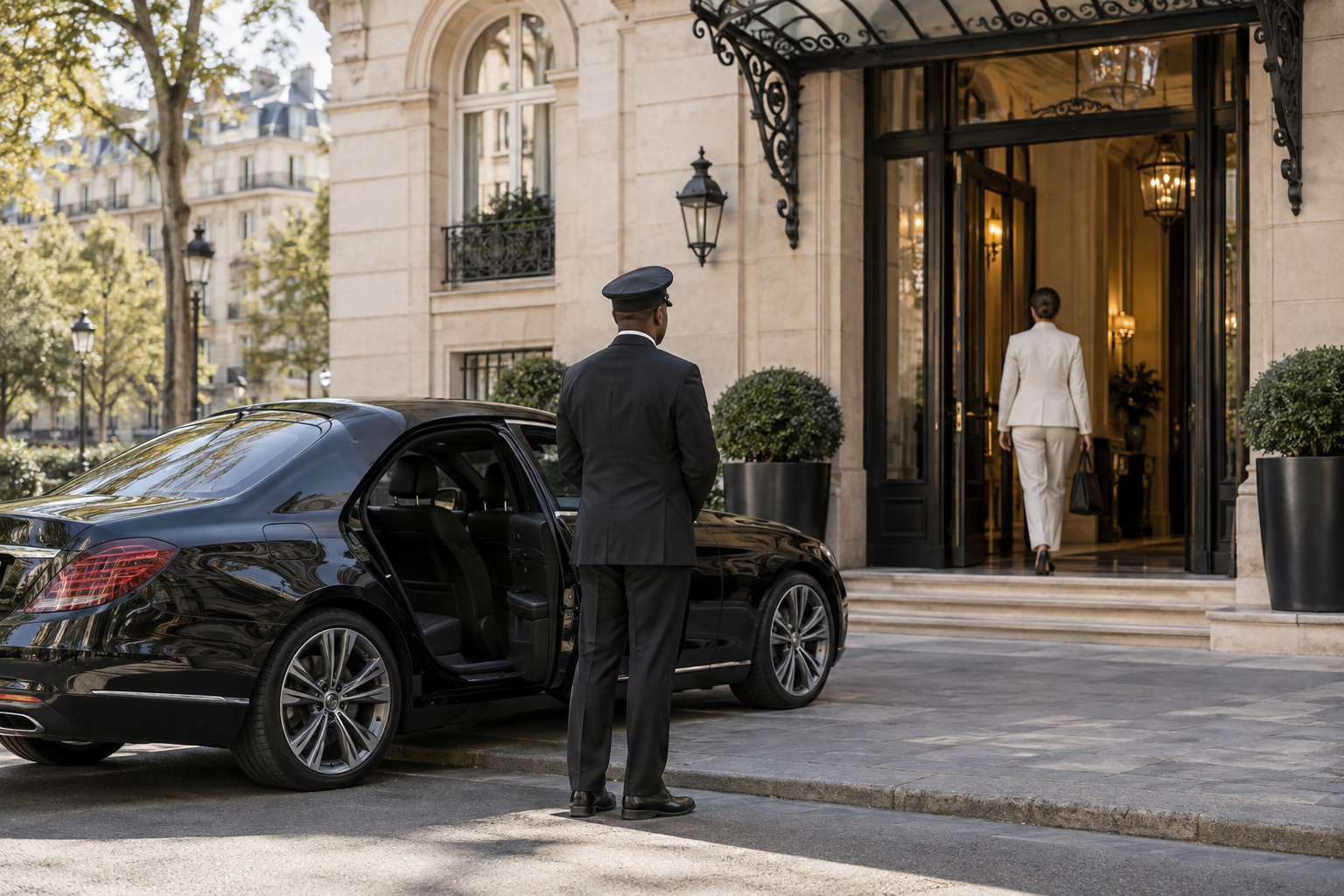
Conceptual illustration of waiting within an hourly chauffeur schedule, not a photograph of the service.
Ask for confirmation using a clear brief
A concise request should make the intended operating pattern visible. For a direct journey, provide the pickup, destination, desired pickup context, passenger details, luggage and any intermediate stop, then ask whether a point-to-point transfer is available.
For an hourly or full-day booking, provide the starting location, the expected operating area, the kinds of stops involved, the waiting requirements and the intended end point. If the schedule includes business meetings, shopping, hospitality or an event, identify which appointments are fixed and which movements need flexibility.
For a route beyond Paris, name every essential destination and clarify whether the plan includes a return to Paris. Do not rely on “Normandy trip” or “service in France” as a complete description. The operator needs the actual route to assess the request against the services presented on the site.
The next practical choice is between a direct transfer requiring confirmation and an hourly, as-directed itinerary with defined boundaries. Once that choice is clear, use the relevant information on the France Limousine Services website to submit a request that states the route, stops, waiting plan and passenger needs.